Collection: What is a Bartending Guide?

Cocktails, Mocktails, and Everything Between: How Bartending Guides Help You Mix for Every Guest at the Table

Table of Contents
- What Is a Bartending Guide?
- The Zero-Proof Shift: Why Mocktails Now Belong in Every Bar Guide
- What Makes a Bartending Guide Different?
- A Brief History of Bartending Guides
- Why ilubra Guides Are Built Differently
- The Bottom Line
- Further Reading
What Is a Bartending Guide?
A bartending guide is a quick-reference tool that keeps drink formulas, ratios, and technique details in one place so you can pull the right answer without breaking stride.
These guides are not written to teach you how to bartend. They assume the craft is already there. What they deliver is the specific ratio, substitution, or technique note you need to execute a drink correctly when time is short and the bar is full.
Beyond recipes, a well-built bartending guide typically includes a small glossary of drink terms, tips on stocking a home bar, glassware recommendations for different drink styles, and garnish suggestions for both presentation and flavor. It is a single resource that covers the full picture of what goes into making a great drink.
How Is a Bartending Guide Different from a Cocktail Book, Recipe App, or Spirits Compendium?
A cocktail book is written to be read. It tells stories, traces origins, and sparks ideas. A spirits compendium covers history, production methods, and tasting notes for individual categories. A recipe app requires a screen, a connection, and several taps. A bartending guide is built for the bar itself: compact, immediate, and useful mid-service.
It is also different from a training manual. A training manual teaches you procedures. A bartending guide assumes the procedures are already learned. It answers the question in front of you right now, while a line of customers is waiting.
Bartending guides come in different formats: laminated cocktail cards, spiral-bound ratio references, wall charts of classic builds, pocket conversion sheets for measurements. The format fits the environment. The function stays constant.
At a glance means something specific behind a bar. The answer has to be visible in a second or two, without scrolling, searching, or asking. A well-built bartending guide is designed around exactly that constraint.
Julian Reed, Mixologist expert shared: "The sober-curious shift did not just change what guests were ordering. It changed what a bartender needs to know. A zero-proof drink built on technique is just as demanding as a classic cocktail, and a good guide makes sure you are prepared for both ends of the menu."
The Zero-Proof Shift: Why Mocktails Now Belong in Every Bar Guide
For most of bartending history, a bar guide meant a cocktail guide. That has changed significantly.
Today, 62% of U.S. adults report drinking less than they used to. The sober-curious movement, once a niche lifestyle choice, has become a mainstream cultural shift. Restaurants are responding directly to it: 44% have expanded their mocktail menus in recent years to meet rising demand from health-conscious guests. A bar program that can't deliver a compelling non-alcoholic drink is now leaving nearly half the table underserved.
The drinks themselves have changed too. Early non-alcoholic bar guides leaned on juice, simple syrup, and soda. Modern zero-proof bartending borrows from culinary technique: house-made shrubs, botanical infusions, fermented bases, and layered flavor structures that hold their own next to any cocktail on the menu.
The best bartending guides today reflect this. A zero-proof section is no longer an afterthought or a short appendix. It's a full, equal part of the reference. Guides that cover both sides of the bar serve a much wider audience and are more useful in more settings, from professional service to home entertaining.
What Makes a Bartending Guide Different?
The best bartending guides share four qualities that make them work in a real bar environment:
1. Concise Format
Everything is cut to what you actually use. Tasting notes and origin stories are left out. What stays is the ratio, the garnish, the glass, and any critical technique note. Nothing else earns a spot on the page.
2. Organized Structure
Drinks are grouped in a way that mirrors how you actually work: by spirit category, drink family, or occasion. You can scan to the right section in seconds and find the entry you need without reading past it.
3. Task-Oriented Content
A bartending guide is organized around tasks, not topics. Are you building a sour? Riffing on a classic? Handling a zero-proof order at a table that has both drinkers and non-drinkers? Each task has its own section with only the information relevant to it.
4. Standalone Utility
A good bartending guide does not send you to a second source. Measurements, glassware recommendations, garnish suggestions, and substitutions are in the same entry as the base recipe. You get the full picture in a single lookup.
Those four qualities translate into three clear benefits when you are actually working:
Consistent Quality
Drinks taste the same every time because the ratios are the same every time. A bartending guide takes personal memory out of the equation on the drinks that matter most.
Faster Service
Busy shifts run smoother when the answer to any question about a build or substitution takes two seconds instead of two minutes. A reference guide eliminates the hesitation.
Confidence Under Pressure
Checking a guide during service is not a sign of weakness. It is the same discipline a surgeon applies with a pre-op checklist. It is what precision looks like in practice.
A Brief History of Bartending Guides
The idea of writing down drink recipes for practical use goes back much further than most people realize. From early distillation manuals to the modern zero-proof movement, each era produced its own reference tools because each era had its own set of drinks to get right.
Apothecary and Distillation Manuals (1600s–1800s)
The earliest printed drink guides were not written for bartenders. They were medical and industrial texts. Books like The London Distiller (1638) and early American compounding manuals focused on how to produce medicinal cordials, bitters, elixirs, and fruit shrubs, the direct ancestors of today's cocktail bitters and shrub-based mocktails. The language was technical, the audience was professional, and the purpose was accurate reproduction of a formula.
The First Printed Cocktail Definition (1806)
The earliest known printed analysis of a cocktail appeared on May 6, 1806, in The Balance and Columbian Repository, an American political newspaper. It defined a cocktail precisely: "a stimulating liquor, composed of spirits of any kind, sugar, water, and bitters." It was the first time anyone put a formal written definition to what bartenders were already making.
University Guides (1827)
The earliest known book dedicated entirely to mixed drinks is Oxford Night Caps by Richard Cook, published in England in 1827. It was written as a practical reference for Oxford University students preparing traditional punches, flips, and nogs. The recipes were specific, the format was compact, and the target reader already knew how to pour.
The Golden Age of Bartending Guides (1862–1900)
The decades following the American Civil War produced the first generation of bartending guides written by working professionals for other working professionals.
Jerry Thomas (1862): Often called the Father of American Mixology, Thomas published The Bar-tenders' Guide: How to Mix Drinks, or The Bon Vivant's Companion. It was the first comprehensive manual written by a practicing bartender specifically to codify the trade. It also included elaborate temperance drinks, such as orgeat lemonades, shrubs, and fruit-forward combinations that would look at home on a modern non-alcoholic menu.
Harry Johnson (1882): Johnson released The New and Improved Illustrated Bartenders' Manual; or, How to Mix Drinks of the Present Style. Beyond recipes, it introduced professional rules, regulations, and standardized measurements to the trade, moving bartending guides from personal notebooks toward something closer to a professional standard.
The Prohibition and Post-Prohibition Era (1900s–1980s)
Prohibition reshaped bartending literature in the United States while accelerating it everywhere else.
The Ideal Bartender (1917): Written by Tom Bullock, this is the first cocktail guide published by an African-American bartender. It featured over 170 pre-Prohibition recipes and remains a landmark in the history of the trade.
The Savoy Cocktail Book (1930): While American bars closed under Prohibition, British and international guides flourished. Harry Craddock's Savoy Cocktail Book became the most influential of the era, capturing the standard for classic cocktails that still shapes bar culture today.
Post-War Slump: Following World War II, bartending guides became sparse. The focus shifted toward basic hospitality rather than craft. Drink quality declined alongside the literature, a connection that was not lost on the generation that eventually reversed it.
The First Standalone Non-Alcoholic Guides (1930s)
The word "mocktail" was coined around 1916. The first major standalone non-alcoholic drink book followed shortly after: Prohibition Punches (1930) by Roxana B. Doran, which set out to make dry gatherings fashionable during the Prohibition era. It was a reference guide for a category that had no trade vocabulary yet.
The Mid-Century Juice Era (1950s–1990s)
For several decades, non-alcoholic drink literature stagnated. Books from this era leaned heavily toward sweet, novelty drinks aimed at children and designated drivers. The repertoire rarely moved beyond basic juice blends, punches, and the Shirley Temple. Craft was not the priority.
The Zero-Proof Movement (2010s to Present)
The arrival of the sober-curious movement and the invention of high-end distilled non-alcoholic spirits triggered a complete reset for non-alcoholic bartending literature. Books like Good Drinks (2020) by Julia Bainbridge and ZERO by the Alinea culinary team brought advanced techniques such as fermentation, fat-washing, and complex flavor layering to a category that had been synonymous with fruit punch. Non-alcoholic bartending reference guides became serious professional tools for the first time.
Why ilubra Guides Are Built Differently
ilubra was built for people who perform at a high level and know what it costs to get a detail wrong.
A bartender with ten years behind the stick still keeps a laminated classic cocktail recipes guide within arm's reach. Not because the classics have changed, but because a packed Friday night is not the moment to second-guess the ratio of sweet to sour in a Sidecar.
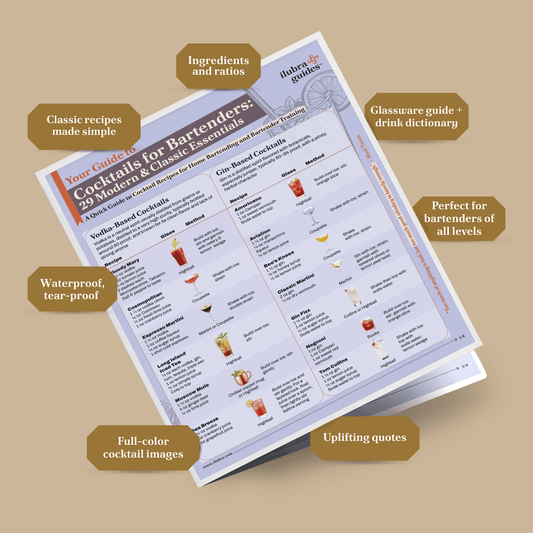
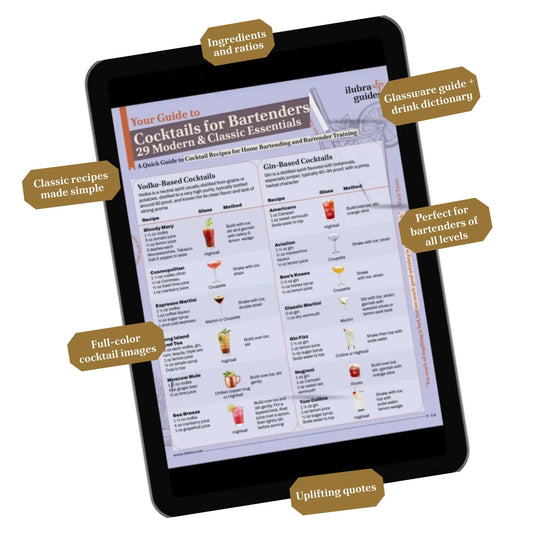
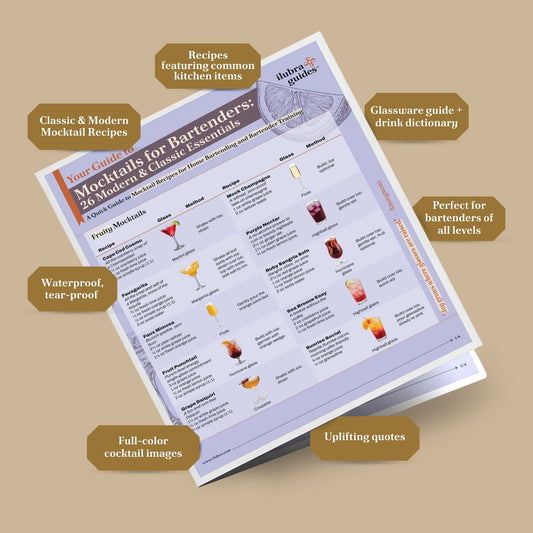
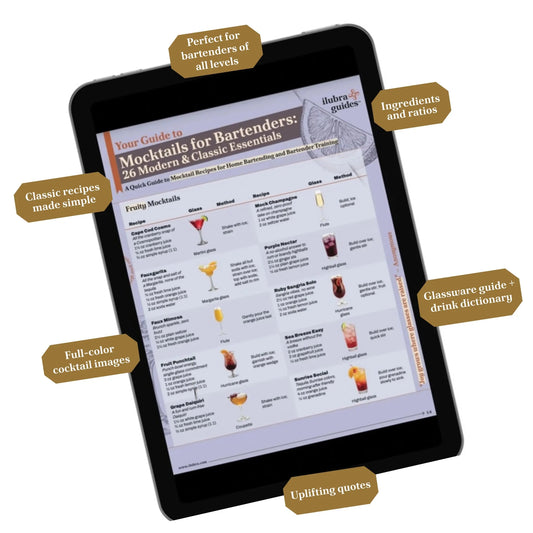
The Zero-Proof to Full-Proof Cocktail & Mocktail Bundle is built on two core principles: no pre-made mixes and no obscure ingredients. Every drink in the collection uses what you already have or can find at any well-stocked grocery store. The guide covers both ends of the bar, balancing classic Prohibition Era mocktails like the Milk Fizz and the Maple Ginger Switchel with newer popular drinks like the Fauxgarita and the Nojito. Whether your guest is sober-curious or ordering their third Negroni, you have something worth making.
Explore the Zero-Proof to Full-Proof Cocktail & Mocktail Bundle at ilubra.com.
The Bottom Line
A bartending guide does not tell you how to bartend. It tells you the exact ratio, formula, or name you need while you are doing it. That matters when the bar is three-deep and someone orders a Last Word, and it matters just as much when the table next to them asks for something that has never touched a spirit.
The history of bartending literature is a history of working professionals writing things down so other working professionals could get them right. From Jerry Thomas codifying the trade in 1862 to the zero-proof movement reinventing non-alcoholic craft, every era produced its own reference tools because every era needed them.
A cocktail book inspires. A spirits guide informs. A bartending guide keeps you accurate when it counts, for every drink, for every guest.
Further Reading
- Bar Vademecum. (n.d.). Bartending Literature and Reference History. bar-vademecum.eu.
- Thomas, J. (1862). The Bar-tenders' Guide: How to Mix Drinks. Dick & Fitzgerald.
- Johnson, H. (1882). The New and Improved Illustrated Bartenders' Manual. Johnson.
- Bullock, T. (1917). The Ideal Bartender. Buxton & Skinner Stationery Co.
- Craddock, H. (1930). The Savoy Cocktail Book. Constable & Co.
- Doran, R. B. (1930). Prohibition Punches. Fleming H. Revell Company.
- Bainbridge, J. (2020). Good Drinks. Ten Speed Press.
- Punch Drink. (n.d.). The Mocktail Has Been Here All Along. punchdrink.com.
- Drink Cut Above. (n.d.). From Spirits to Zero-Proof: The Story Behind Cocktails and Mocktails. drinkcutabove.com.
-
Cocktail+Mocktail Recipes Guide Bundle – 29 Cocktails, 26 Mocktails, Waterproof (Print Edition)
Regular price $17.90Regular price -
Bartending Guides Bundle: Zero-Proof to Full-Proof Cocktail & Mocktail Recipes (Digital Download)
Regular price $13.90Regular price -
Your Guide to Mocktails for Bartenders: The Most Popular Mocktails at Your Fingertips (Print Edition)
Regular price $8.95Regular price -
Your Guide to Mocktails for Bartenders: The Best Mocktails at Your Fingertips (Digital Download)
Regular price $6.95Regular price -
Your Guide to Cocktails for Bartenders: The Best Cocktails at Your Fingertips (Print Edition)
Regular price $8.95Regular price -
Classic Cocktail Guide: Your At-a-Glance Companion (Digital Download)
Regular price $6.95Regular price