Collection: What is a Bible Guide?
Still Flipping Through Pages? Bible Guides Help You Study Deeper, Find Answers Faster, and Remember More

Table of Contents
- What Is a Bible Guide?
- How Is a Bible Guide Different from a Commentary, Study Bible, or Concordance?
- What Makes a Bible Guide Different?
- A Brief History of Bible Guides
- Why ilubra Guides Are Built Differently
- The Bottom Line
-
Further Reading
What Is a Bible Guide?
A Bible guide is a short, organized tool that keeps the most important facts about Scripture in one place. It's built for moments when you need a quick answer, not a long lesson.
Speed is the whole point. A Bible guide is not trying to teach you everything. It's built to get you the right answer right now, so you can keep studying, teaching, or applying what you've learned.
How Is a Bible Guide Different from a Commentary, Study Bible, or Concordance?
A commentary explains meaning in depth. A concordance lists every occurrence of a word. A study Bible embeds notes and maps into the full text. A Bible guide is different: it pulls only the most useful facts and organizes them for fast retrieval.
A Bible guide is also different from a devotional. A devotional inspires reflection. A Bible guide gives you the facts you need to act or study right now.
You may have heard the phrase "answers at a glance." That's exactly what a Bible guide does. Unlike a textbook or commentary you read straight through, a Bible guide is something you consult. You pick it up when you need it.
Gabriel Gregory Greene, Biblical Scholar says: "Every serious student of Scripture eventually discovers that knowing where to look is just as important as knowing what to read. A well-organized Bible guide bridges that gap."
What Makes a Bible Guide Different?
Good Bible guides share four key qualities. Here's what makes them work:
1. Concise Format
A Bible guide strips a topic down to what you actually use. No backstory. No lengthy theological debate. Just the facts, verses, and cross-references most relevant to the task at hand.
2. Organized Structure
Everything is set up for fast finding. Sections have clear names you can scan at a glance. Tables and short lists replace long paragraphs wherever possible.
3. Task-Oriented Content
A Bible guide is not organized by topic alone. It's organized by what you're trying to do right now. Are you preparing a lesson? Looking up a specific term? Tracking a theme across books? The guide anticipates your task and delivers what you need.
4. Standalone Utility
A good Bible guide gives you what you need without sending you elsewhere. You should not have to open three other books to make sense of it.
These four qualities produce three real benefits:
Boosted Efficiency
Bible guides cut the time you spend hunting for answers. Instead of flipping through a concordance, searching online, or scanning margins, you find it in seconds.
Increased Retention
Using a Bible guide actually helps you remember things. Looking up information in a well-organized guide reinforces it. Over time, what you look up repeatedly becomes what you know.
Reduced Errors
When the facts are right in front of you, you are less likely to misquote, misattribute, or misapply a passage.
A Brief History of Bible Guides
People have always wanted to keep important knowledge from Scripture close at hand. That's not a modern idea. It has roots in the earliest days of the church.
Early Beginnings: Personal Devotion and Collective Study
Bible study originated with the early church fathers. They read, copied, and discussed Scripture both privately and together. Organizing key passages for quick retrieval was part of their practice from the beginning.
The Geneva Bible (1560): The Ancestor of the Modern Study Bible
The Geneva Bible is often called the first modern study Bible. It was the first widely distributed Bible to include extensive marginal notes, chapter summaries, and cross-references. Readers could study the text and access reference material at the same time.
17th Century: The King James Bible's 7,000 Marginal Notes (1611)
When the King James Bible was published in 1611, it included over 7,000 marginal notes. Most provided alternative translations or pointed to related passages. Readers expected their Bible to come with reference tools built in.
Cruden's Concordance (1737)
Alexander Cruden published his Complete Concordance to the Holy Scriptures in 1737. It became one of the most widely used reference tools in the English-speaking Christian world, helping readers locate any word or passage quickly.
1800s: Wide-Margin Bibles and Personal Annotation
During the 1800s, publishers began producing Bibles with extra-wide margins. Readers used these spaces to write their own notes, cross-references, and observations. Personal annotation became a common study practice.
Treasury of Scripture Knowledge (1835)
This large reference work compiled thousands of cross-references and parallel passages. It became a foundational tool for study Bibles that followed, including the Scofield Reference Bible.
The Thompson Chain-Reference Bible (1908)
Frank Charles Thompson introduced a system for tracking themes and topics throughout the entire Bible. His chain-reference method linked related verses together, letting readers follow a single idea from Genesis to Revelation.
20th Century: The Scofield Reference Bible (1909)
One year after Thompson, the Scofield Reference Bible brought notes and theological commentary directly into the printed Bible. It became one of the most influential study Bibles of the 20th century.
The Rise of Study Bibles (20th Century)
The 1917 revised Scofield Study Bible marked a shift in how people used their Bibles. Notes, commentary, and reference tools were no longer separate volumes. They were built into the text itself. This model shaped every major study Bible that followed.
Modern Era (Late 20th Century to Today)
Bible study guides expanded into specialized formats built for specific needs:
- Historical and cultural focus: Guides like the Holman Bible Atlas help readers understand the geography and setting of Scripture.
- Chronological guides: Tools that help readers navigate the Bible in the order events occurred, not the order they appear in print.
- Topical reference guides: Compact guides that organize key verses by theme, useful for teaching, counseling, and personal study.
Why ilubra Guides Are Built Differently
ilubra was built for people who take what they do seriously, whether you're a student, a teacher, a small group leader, or someone who simply wants to get more out of time in the Word.
A Bible student preparing for a seminary exam still reaches for a reference guide when reviewing the books of the Old Testament or the timeline of Paul's missionary journeys. Knowing the material well and having a reliable reference guide are not opposites.
A small group leader with years of Bible study experience still consults a topical reference guide when planning a lesson. Having the key themes of a book organized in one place saves preparation time and sharpens focus.
A pastor who knows Scripture deeply still keeps a reference guide close during sermon preparation. When the details matter — and the details always matter — a well-built guide helps you get them right.
The Bottom Line
Using a Bible guide does not mean you don't know your Scripture. It means you care about getting it right. The scholars and church leaders who shaped Christian study tools over five centuries understood that good reference tools make serious study possible.
History backs it up. From the Geneva Bible's marginal notes to the Thompson Chain-Reference system to today's study guides, people have always found ways to keep important knowledge close at hand.
A devotional builds your faith. A commentary deepens your understanding. A Bible guide helps you use what you know when it counts.
Further Reading
- Daniell, D. (2003). The Bible in English: Its History and Influence. Yale University Press.
- Cruden, A. (1737). A Complete Concordance to the Holy Scriptures. London.
- Thompson, F. C. (1908). The Chain Reference Bible. B.B. Kirkbride Bible Company.
- Scofield, C. I. (1909). The Scofield Reference Bible. Oxford University Press.
- Holman Bible Publishers. (2006). Holman Bible Atlas. Nashville: Holman Reference.
- Goodrick, E. W., & Kohlenberger, J. R. (1990). The NIV Exhaustive Concordance. Zondervan.
- The Geneva Bible: A Facsimile of the 1560 Edition. (1969). University of Wisconsin Press.
-
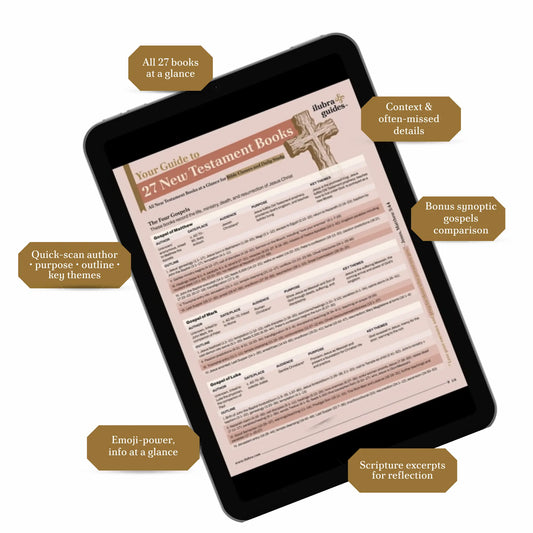
Guide to the Books of the New Testament: From the Gospels to Revelation (Digital Download)
Regular price $8.95Regular price -
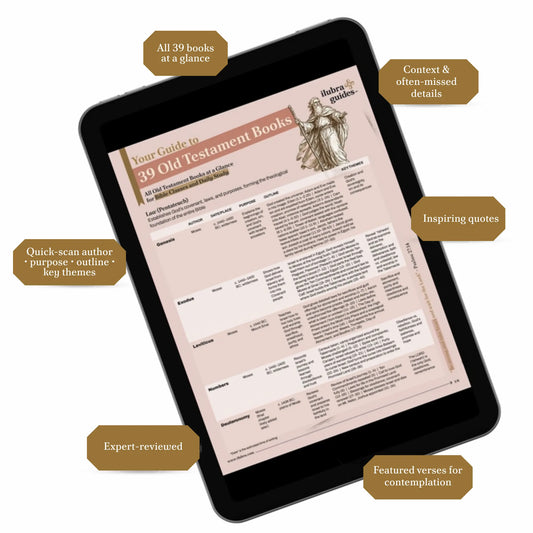
Books of the Old Testament: A Guide from Genesis to Malachi (Digital Download)
Regular price $8.95Regular price -
Bible Study at a Glance: Old + New Testament Bundle (Digital Download)
Regular price $17.90Regular price