Collection: What is a Holistic Health Guide?
Lost in the Details? Holistic Health Guides Help You Work Confidently, Blend Accurately, and Recommend with Care
Table of Contents
- What Is a Holistic Health Guide?
- How Is a Holistic Health Guide Different from a Textbook, Journal, or Encyclopedia?
- What Makes a Holistic Health Guide Different?
- A Brief History of Holistic Health Guides
- Why ilubra Guides Are Built Differently
- The Bottom Line
-
Further Reading
What Is a Holistic Health Guide?
A holistic health guide is a quick-reference tool that organizes the most important facts about natural wellness in one place. It covers subjects like essential oils, crystals, vitamins, and herbal remedies.
These guides don't try to explain everything. They assume you already know the basics. What they give you is the exact detail you need right now: a contraindication, a dosage threshold, a blending ratio.
How Is a Holistic Health Guide Different from a Textbook, Journal, or Encyclopedia?
A textbook teaches concepts from scratch. A wellness journal records personal experience. An encyclopedia covers every angle of a topic. A holistic health guide does something narrower: it delivers a specific fact at the moment you need it.
It's also different from a protocol guide or recipe book. Those walk you through a process step by step. A holistic health guide assumes you already know the process. It fills in the specific facts you need to do it correctly.
This is what "at a glance" actually means. You don't sit down and read a holistic health guide cover to cover. You reach for it when a specific question comes up, find the answer, and get back to work.
What Makes a Holistic Health Guide Different?
Every good holistic health guide shares the same four qualities:
1. Concise Format
Information is trimmed to essentials. No background narrative, no extended explanation of origins or discovery. Just the data a practitioner needs: properties, uses, cautions, and interactions.
2. Organized Structure
The layout makes fast scanning possible. Each entry follows a consistent pattern. Tables, grids, and short categories replace long paragraphs. You find what you need by scanning, not reading.
3. Task-Oriented Content
The information is grouped around what you're actually doing. Checking an oil before a client consultation? Verifying a supplement interaction? Confirming which stones support a specific intention? Each task has its own section.
4. Standalone Utility
A good holistic health guide doesn't require another source to complete its picture. Cautions, dosages, and contraindications sit in the same place as the core properties. You can answer the question without opening anything else.
These four qualities produce three concrete benefits for practitioners:
Boosted Accuracy
Natural wellness work involves a lot of precise detail: concentrations, interaction risks, individual contraindications. A reference guide puts those details in front of you at the moment you need them most.
Time Saved During Practice
Client sessions move quickly. Preparation time is limited. A well-organized reference guide means less time searching and more time focused on the person in front of you.
Stronger Client Confidence
When a practitioner reaches for a guide mid-session, it signals precision and care, not uncertainty. Clients notice the difference between someone who is guessing and someone who is checking.
Taylor Thames, Holistic Health expert, shared: "I have seen practitioners with decades of experience reach for a reference mid-session. That is not a gap in their knowledge. That is what genuine care for the client looks like."
A Brief History of Holistic Health Guides
Long before printed guides existed, healers and scholars were recording what they knew about plants, minerals, and the human body. The desire to organize that knowledge for practical, repeatable use is as old as practice itself.
c. 3000 BCE: The First Recorded Healing Formulas (Sumer)
The ancient Sumerians documented some of the earliest known healing rituals, including formulas that assigned protective and therapeutic roles to specific stones such as lapis lazuli and carnelian. These records represent the first attempt to systematize natural healing knowledge.
c. 2697–2597 BCE: The Yellow Emperor's Book of Internal Medicine (China)
One of the oldest surviving medical texts, this Chinese classic contains the earliest written records of using aromatic plants to support health and physical balance. It laid the groundwork for centuries of Eastern wellness practice.
c. 1550 BCE: The Ebers Papyrus (Egypt)
The Ebers Papyrus is one of the ancient world's most detailed practical guides to natural health. It functions as a recipe guide, detailing how to blend aromatics like myrrh and frankincense for medicinal purposes.
c. 315 BCE: Theophrastus and On Stones (Greece)
Theophrastus, a student of Aristotle, published On Stones, one of the first systematic attempts to categorize minerals by their physical properties and perceived effects. His work shaped European mineralogy for centuries.
77 CE: Pliny the Elder and the Naturalis Historia (Rome)
Pliny the Elder expanded significantly on earlier mineral work in his encyclopedic Naturalis Historia, documenting the therapeutic and talismanic properties of gems including amethyst.
High Middle Ages: Hildegard von Bingen and Physica
The German abbess and polymath Hildegard von Bingen developed one of the most thorough organized references to natural remedies in medieval Europe. Her work Physica documented over 230 plants and linked them to specific therapeutic applications.
c. 1300: Arnold de Villanova and Distilled Essential Oils (Catalonia)
The Catalan physician Arnold de Villanova wrote the first authentic medical description of a distilled essential oil. His documentation marked a turning point: natural remedies were beginning to shift from folklore to formulated reference.
1753: James Lind and A Treatise of the Scurvy (Scotland)
Scottish physician James Lind published A Treatise of the Scurvy, the first definitive guide demonstrating that citrus fruit could both cure and prevent scurvy in sailors. It was a landmark in evidence-based nutritional reference.
1907: Mysteries of Crystal Science
The publication of Mysteries of Crystal Science signaled a shift in how stones were being approached. Scholarly interest was moving toward the esoteric and metaphysical properties of crystals, setting the stage for modern crystal reference guides.
1922: The Vitamins (United States)
Authors S.L. Smith and H.C. Sherman published The Vitamins, a comprehensive reference detailing the properties, identification, and distinct roles of early micronutrients including Vitamin A and Vitamin B.
1937: René-Maurice Gattefossé and the Birth of Aromatherapy (France)
Gattefossé coined the term "aromatherapy" and published his landmark book of the same name. He had famously discovered the healing properties of lavender oil after burning his hand in a laboratory accident, leading to systematic documentation of essential oil applications.
1941: The First Official Recommended Dietary Allowances (United States)
The U.S. Food and Nutrition Board released the first official RDAs: a structured nutritional guide detailing exactly how many milligrams of vitamins A, B1, B2, B3, C, and D humans required daily to avoid deficiency.
1970: Linus Pauling and Vitamin C (United States)
Nobel laureate Linus Pauling published Vitamin C and the Common Cold, a bestseller that introduced high-dose nutritional supplementation to mainstream consumer culture. For the first time, nutritional reference material was aimed at the general public.
1977: Robert B. Tisserand and The Art of Aromatherapy (United Kingdom)
Tisserand published the first essential oil guide written in the English language. It introduced aromatherapy reference material to a broad English-speaking audience and became the blueprint for the modern practitioner reference guide.
Why ilubra Guides Are Built Differently
ilubra was built for practitioners who take precision seriously, whether you are newly trained or years into your practice.
An aromatherapist with a full client roster and years of clinical training still consults an essential oils reference guide before blending. Not because she has forgotten which oils are contraindicated during pregnancy. Because precision is not optional when a client is sitting across from you.
The Bottom Line
A holistic health guide is not a crutch. It is a professional tool. Practitioners in every field that demands precision, from medicine to natural wellness, rely on reference materials as a matter of standard practice.
The history of holistic health is a history of people recording what they learned so others could use it accurately. From the Ebers Papyrus to Tisserand's aromatherapy guide, every major step forward in natural wellness was accompanied by a reference tool designed to help practitioners get the details right.
A training manual builds your skills. A holistic health guide helps you put them to work correctly when it matters.
Further Reading
- Morgan's Apothecary. (n.d.). History of Essential Oils. morgansapothecary.com.
- Pliny the Elder. (77 CE). Naturalis Historia. Translated by H. Rackham. Harvard University Press.
- Gattefossé, R.-M. (1937). Aromatherapy. London: C.W. Daniel.
- Tisserand, R. B. (1977). The Art of Aromatherapy. C.W. Daniel Company.
- Pauling, L. (1970). Vitamin C and the Common Cold. W. H. Freeman.
- U.S. Food and Nutrition Board. (1941). Recommended Dietary Allowances. National Academy of Sciences.
- Smith, S. L., & Sherman, H. C. (1922). The Vitamins. Columbia University Press.
- Hildegard von Bingen. (c. 1150). Physica. (Trans. Priscilla Throop, 1998). Healing Arts Press.
- Wikipedia. (n.d.). History of USDA Nutrition Guidelines. en.wikipedia.org.
-
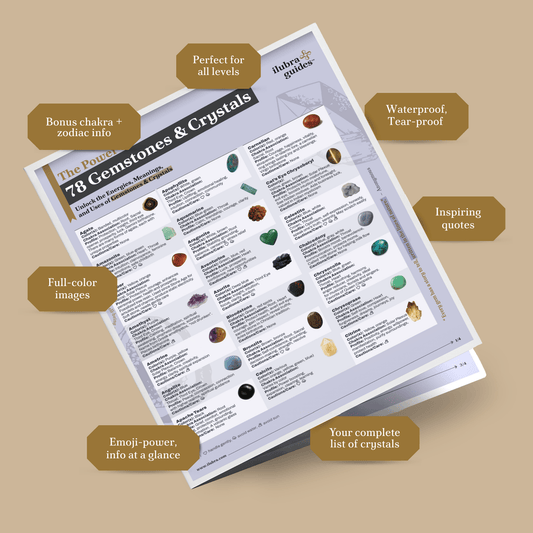
The Power of 78 Gemstones & Crystals: Your Essential Gemstones & Crystals Guide (Digital Download)
Regular price $6.95Regular price -
Holistic Health Guide Bundle: Vitamins, Essential Oils, Gemstones & Crystals (Print Edition)
Regular price $26.85Regular price -
Holistic Health Guide Bundle: Vitamins, Essential Oils, Gemstones & Crystals (Digital Download)
Regular price $20.85Regular price -
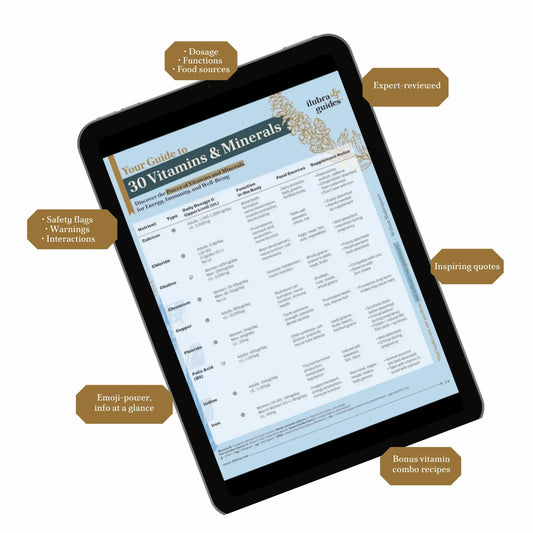
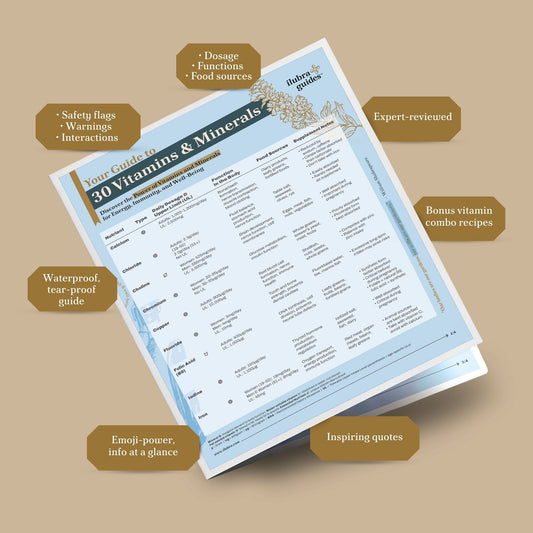
Vitamins & Minerals List: At-a-Glance Guide to 30 Essential Nutrients (Print Edition)
Regular price $8.95Regular price -
The Power of 78 Gemstones & Crystals: Your Ultimate Crystals Type Guide (Print Edition)
Regular price $8.95Regular price -
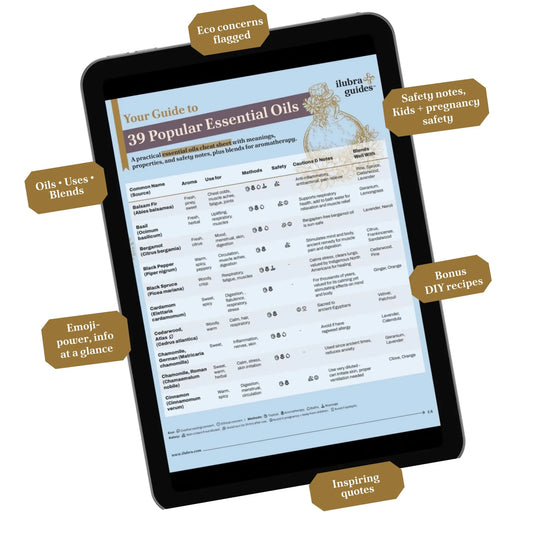
Essential Oils Reference Guide: Your At-a-Glance Companion (Print Edition)
Regular price $8.95Regular price -
Essential Oils Reference Guide: Your At-a-Glance Companion (Digital Download)
Regular price $6.95Regular price